
The Impact Diligence Gap
The playbook for financial due diligence is well established – and investors in private market funds have decades of shared practice to draw on when developing their diligence processes.
But that playbook focuses only on the question of whether a manager is likely to generate strong financial returns. It doesn’t help an investor assess whether a manager is actually likely to achieve positive impact.
That’s the gap impact due diligence closes. Rigorous diligence of a fund means evaluating a manager’s impact competencies and risks alongside its financial ones: How credible is the impact thesis? Does the team have the required expertise to deliver on impact? Are the investment processes built to identify impact opportunities and manage related risks? Ignoring these questions (among others) doesn’t just leave a knowledge gap, it leaves LPs exposed – both to impact and reputational risk and to uncertainty about whether a fund actually fits their mandate and objectives.
Impact Diligence Resources
For the last several years, BlueMark has been focused on providing investors with practical tools and resources to help them assess impact investments with more confidence and rigor. In collaboration with CASE at Duke University, we published A Field Guide: Impact Due Diligence and Management for Asset Allocators, informed by interviews with more than 50 asset allocators and fund managers. With ILPA and Tideline, we developed the LP Impact Primer series, including a framework outlining core questions to ask managers during diligence.
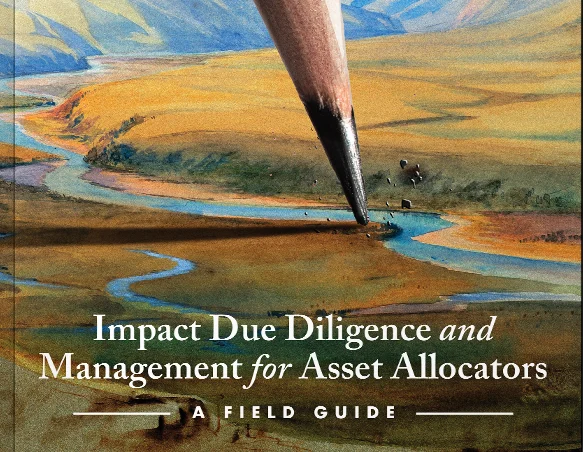
A Field Guide: Impact Due Diligence and Management for Asset Allocators
This resource provides guidance and recommendations to help asset allocators when evaluating prospective managers, as well as strategies for ongoing engagement and management of impact performance. The guide describes the markers of basic and advanced practice in each of five core areas, along with the red flags to watch for. The resource was informed by interviews with more than 50 asset owners and fund managers globally.
The LP Impact Primer series: “Exploring Institutional Impact”
Developed for the ILPA member community, this series provides a foundational orientation to impact investing in private markets. The Opportunity to Invest for Impact in Private Markets outlines the core tenets of the field; Evaluating Impact Funds lays out key diligence questions for managers and what to look for in each answer; and The Role of Independent Verification details how third-party assessment can strengthen decision-making.
The Remaining Challenge
These resources have helped many allocators develop a more robust and rigorous impact diligence process. Yet, many still tell us they lack the data and insights to make confident decisions. And why? Because, even if they know what questions to ask, judging the answers in context is hard. Often, experienced impact investors know exactly what information they want, yet still find it difficult to gather that information or contextualize it against peers. For LPs newer to impact investing, this is compounded by a steep learning curve. Unfamiliar concepts can be enough to keep some newer entrants on the sidelines and lead others to spend significant time and resources without gaining additional clarity.
What’s been largely missing from the impact investing market are two things traditional finance has had for decades:
- Comparative metrics, benchmarks, and scoring to assess an investment relative to peers and the market.
- Access to expert third-party opinions and analysis to inform and supplement an underwriter’s analyses.
Without these, LPs end up re-deriving judgment from scratch on every deal, rather than building from peer benchmarks and expert perspectives. This market intelligence helps streamline diligence for experienced LPs and gives newer entrants far more confidence as they enter the market.
Why We Built IQ Diligence
Drawing on our past research and what BlueMark has learned verifying hundreds of GPs globally, we built IQ Diligence to directly address these inefficiencies in impact diligence.
Some of the wisdom baked into our diligence assessments includes:
- Making sure there’s evidence behind the impact thesis – ensuring there’s a documented theory of change with a clear problem statement, targeted outcomes, and data or evidence supporting the proposed solution.
- Probing governance and team incentives, not just policies – ensuring there are impact professionals who sit on the investment committee (or an advisory board) with real influence over deal terms and checking whether the team has dedicated impact expertise at multiple levels of seniority.
- Confirming impact management runs across the full lifecycle – ensuring the GP has its own robust and consistently applied impact diligence process as well as the tools and systems to track and engage with impact results regularly after an investment is made.
Some of the red flags we call out:
- Weak impact positioning and capacity – such as a team that lacks the relevant sector or geographic experience or an under-resourced impact management function
- Superficial reporting – such as reports built on cherry-picked aggregated numbers with no supporting context
- Lack of impact risk assessment – a fund without any approach to anticipating and/or addressing when impact falls short of what’s intended, or for catching negative or unintended outcomes across the portfolio
These criteria, among others, are scored, benchmarked against peers, and supplemented with expert commentary to strengthen decision-making.
Impact investing asks managers to deliver on two mandates at once: financial and impact. LPs need a diligence process that reflects that dual mandate. Strong impact due diligence doesn’t replace traditional financial diligence, it complements it, giving LPs the confidence that a manager’s impact claims are credible, comparable, and aligned with their own goals. Like financial diligence, strong impact diligence processes also lay the necessary groundwork for the rest of the investment process: tracking impact performance, engaging on key impact issues, and impact reporting to stakeholders. With BlueMark IQ, we’re working to make quality diligence assessments accessible so LPs can clearly and efficiently separate genuine impact performance from marketing.
To learn more about how IQ Diligence helps allocators confidently assess any private impact fund, get in touch here.