For most companies and financial institutions, annual verification of their external disclosures has become an accepted best practice. Public companies have legal obligations to get their financial statements regularly audited by a third-party, and asset management firms face similar requirements when reporting their financial performance to their investors.
This combination of disclosures and verifications has played a critical role in the evolution of the capital markets system by bringing more transparency and accountability to how business and investment decisions are made. While some may view the practice of preparing and verifying these disclosures as a tedious compliance exercise, this routine can offer important learning and value creation opportunities and reveal meaningful insights about emerging risks and potential opportunities that otherwise may be missed.
Why re-verify?
We are now witnessing a similar evolution towards regular verification in the impact investing market. As more investors launch impact funds and related investment products, there is an ever-growing need for accountability mechanisms to ensure that external-facing materials – whether an impact report, responses to a due diligence questionnaire (DDQ), or a pitch deck – are accurate and actionable for the end user, particularly asset owners and allocators that may rely on these materials for their own due diligence. And because these materials inevitably require updates over time, it is not surprising that investors have begun to continuously seek external verification.
As a part of BlueMark’s 2024 “Making the Mark” report, we conducted an analysis of 23 investors that have sought out repeat verifications. Comparing the most recent verification results of these investors to their previous results, we saw significant improvements across six of the eight practice areas assessed by BlueMark, including portfolio-level impact management (30%), investor contribution (35%), ESG risk management (52%), impact monitoring (43%), impact at exit (52%), impact review (48%).
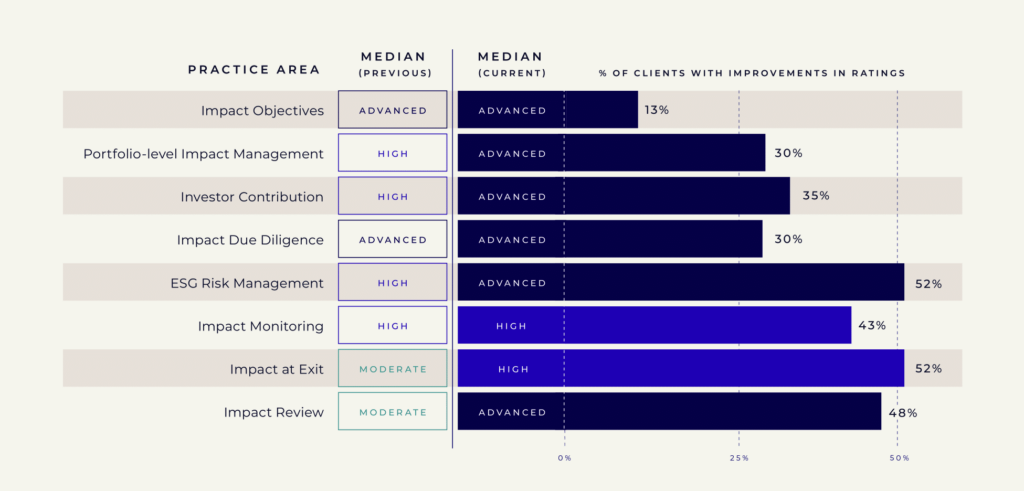
This data demonstrates that re-verification has the potential to significantly strengthen impact management systems over time, and that clients who pursue additional verifications score higher than the median investor, and are more likely to earn the highest possible rating of ‘Advanced’ on the above practices areas. (See the 2024 Making the Mark report to read about BlueMark’s verification methodology.)
Clients who pursue additional verifications score higher than the median investor, and are more likely to earn the highest possible rating of ‘Advanced’ on the above practices areas.
Many investors use the results of their initial verification to benchmark against their peers. They then identify and act on how to further fortify their practices between verifications, leading to the clear correlation between the frequency of verification and the quality of impact management processes.
An added advantage of regular verification is that it enables investors to showcase their commitment to continuous learning and improvement, a common “green flag” that asset allocators look for when evaluating fund managers to ensure that impact management systems and reporting are aligned with current best practices. (For more information on “green flags” and “red flags,” see our “Field Guide” on how asset allocators approach impact due diligence and management.)
A moving target
BlueMark’s data also indicates that ‘best practice’ in impact performance is a moving target, as demonstrated by the four clients who saw their ratings decrease in one practice area upon re-verification. This signals that the industry continues to mature and that what was once considered best practice is now table stakes for sustainable and impact investing. The rapid pace of this maturation provides further evidence on the need for investors to regularly assess how they compare to the current state of the market.
The rapid pace of this maturation provides further evidence on the need for investors to regularly assess how they compare to the current state of the market.
To date, the only two industry standards for impact investors that explicitly require independent verification or assurance are the Operating Principles for Impact Management and the SDG Impact Standards. The former calls for verification at “regular intervals” while the latter is being designed with minimum requirements to “encourage participation and continuous improvement towards best practice.” The Impact Performance Reporting Norms recently introduced by Impact Frontiers also include guidelines related to conducting an independent review of impact reports produced by private market asset managers, however this review is treated as “optional” for now given the need for market actors to first align around a shared set of best practices.
As these and other industry standards help shape the future of impact and sustainable investing, we have a strong conviction that impact verification will become an annual exercise that is treated as just as much a part of being an institutional investor as a financial audit. After all, much can change over the course of a year – investments are made, exits are achieved, strategies are refined – and so it will be increasingly important for investors to assess those changes prior to any external reporting to LPs or other stakeholders.
It’ll be increasingly important for investors to assess those changes prior to any external reporting to LPs or other stakeholders.
The origins and future of verification
BlueMark was founded to fill the gap in the impact and sustainable investing market for regular independent verification. The vision we had for the impact investing community was modeled closely after the vision B Lab had for its community of B Corps. Early on, B Lab recognized the importance of having a standardized framework for assessing companies’ commitment to best practices across key social and environmental issues, which led to the creation of the B Impact Assessment. Today, there are more than 6,000 B Corps spread across 80+ countries, and each B Corp is required to get recertified every three years or in the event of a major business change, like a reorganization or acquisition.
Our own experience of getting certified as a B Corp was a powerful reminder for why we designed our own verification services to be easily accessible and repeatable. A significant number of these verifications have led to tangible improvements in the practices deployed by investors in pursuit of both impact and financial performance. However, as stated above, we found that the most significant improvements are among those investors who have undergone multiple verifications.
Ultimately, for the impact investing market to evolve from transparency to accountability, it is clear that independent verification will play a big role. And for investors who share a goal of scaling the impact investing market with integrity, embracing verification now can signal their commitment to pushing the field forward.